
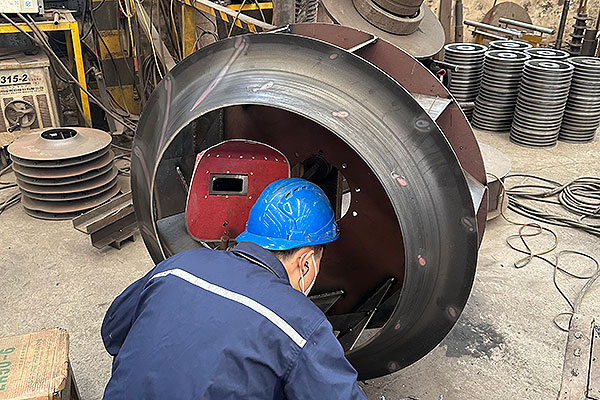
When discussing the performance of centrifugal fans, most people focus their attention on the impeller and motor. However, a core component that is often overlooked—the volute—actually plays a crucial role in the fan's overall efficiency, noise levels, and stability. The volute is not merely an outer casing for the impeller; it is a precision device for directing airflow and converting energy.
The primary function of the volute is to systematically collect the kinetic energy of air expelled at high velocity from the impeller and efficiently convert it into static pressure energy. An excellent volute design requires its profile to adhere to aerodynamic principles. An ideal profile conforming to a logarithmic spiral or Archimedean spiral guides airflow smoothly, minimizing vortex formation and turbulence to reduce energy loss. This means that at the same impeller speed, a well-designed volute can generate higher static pressure and lower noise levels.
Conversely, a poorly designed volute causes internal airflow collisions and friction, resulting in significant energy loss and harsh noise. These losses ultimately manifest as “inefficiency” and “high energy consumption.” Additionally, the size and shape of the volute's inlet and outlet ports directly impact the smoothness of duct connections; improper interfaces introduce additional system resistance. Therefore, when selecting a centrifugal fan, scrutinizing the casing's manufacturing process, material properties (such as the strength of galvanized steel or stainless steel), and aerodynamic design is equally important as evaluating its motor power. Though inconspicuous, it is the silent contributor to the fan's quiet and efficient operation.