
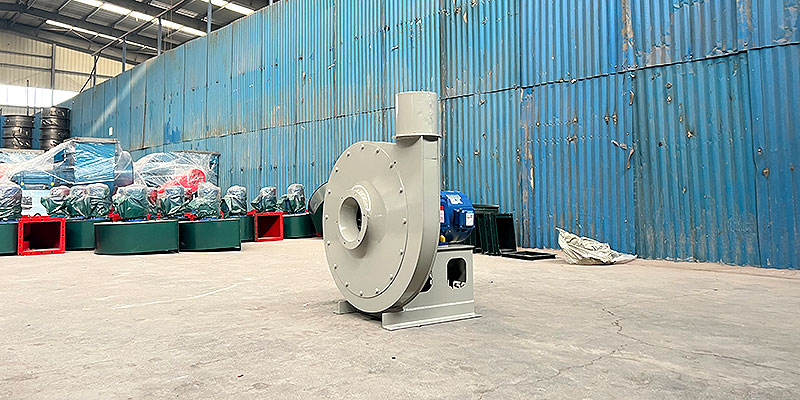
First, in source control, aeroacoustic optimization has become critical. Using computational fluid dynamics (CFD) and acoustic simulation software, engineers can precisely design the profile of impellers and volutes. For instance, employing backward-curved swept blades effectively reduces air separation on the non-working surface of the blades, thereby lowering vortex noise. This root-cause approach to noise suppression proves significantly more effective than passive isolation methods. Secondly, in the propagation path, the application of composite materials has opened new avenues. Traditional metal volutes often act as noise-radiating “speakers.” Now, bonding high-performance polyurethane foam or ceramic fiber acoustic wool inside the volute has become standard practice. Cutting-edge research is exploring carbon fiber composite volutes, whose high internal resistance significantly reduces vibration noise compared to metal.
Furthermore, active noise cancellation technology is transitioning from consumer electronics to industrial applications. By installing microphone and speaker arrays at the fan's inlet or outlet, the system captures noise waves in real time and generates counter-phase sound waves to cancel them out, proving remarkably effective against specific low-frequency noises. The integrated application of these silencing technologies enables modern high-efficiency centrifugal fans to deliver powerful airflow while remaining a “quiet companion.” This meets the stringent requirements of noise-sensitive environments such as data centers, high-end laboratories, and office buildings.